Case Studies

7 Ways to Use Roanuz CricketAPI to Increase Website Sessions: The Justdial IPL 2026 Playbook

May. 28, 2026
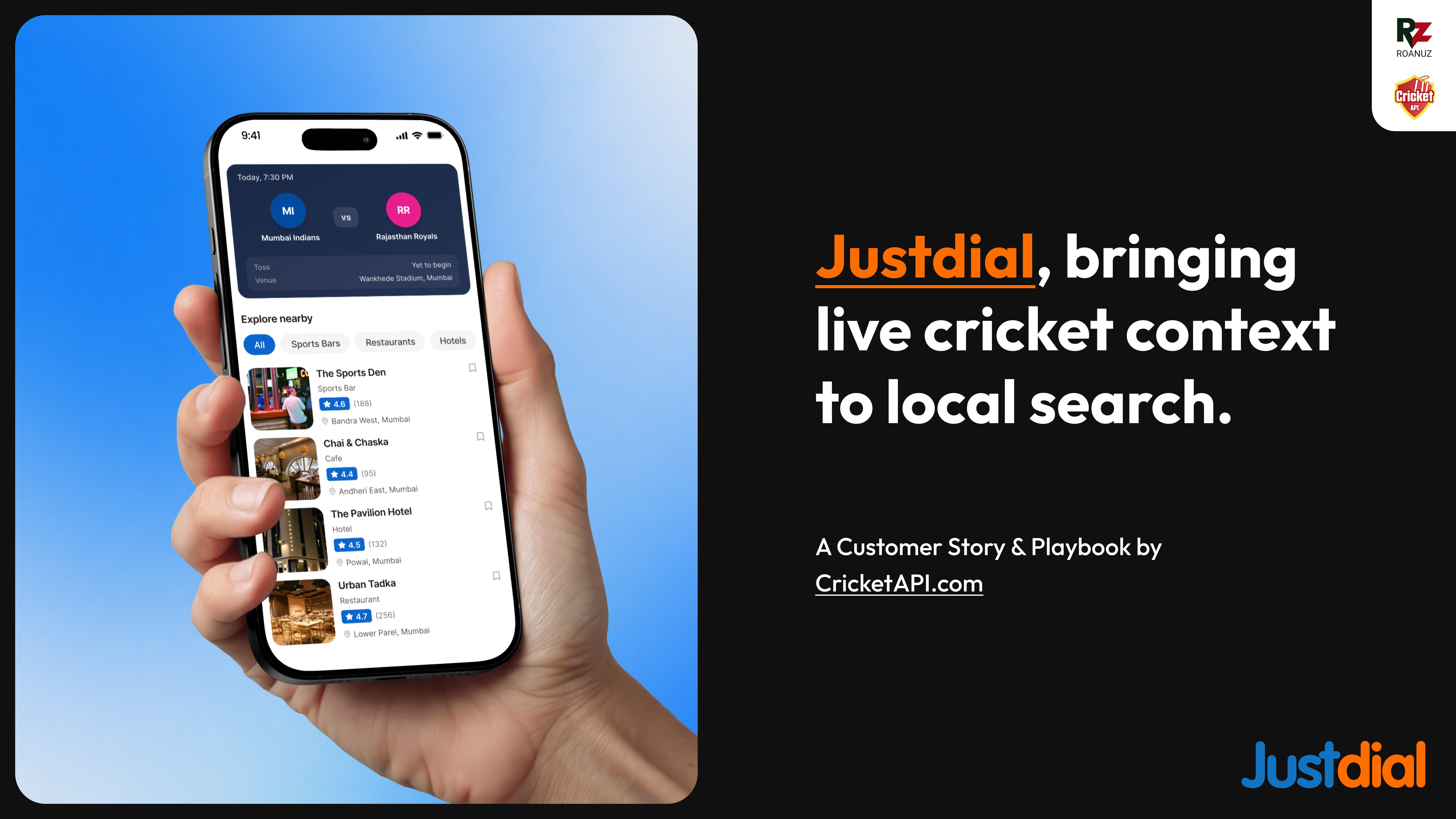
Justdial x Roanuz CricketAPI

Justdial

Cricket fans in India check a score, fixture, or commentary feed 8–12 times a day during IPL. For 60 days straight. That's a recurring intent loop firing across roughly 300 million people, and most non-cricket products treat it as someone else's traffic. Justdial decided not to. Their IPL collection page is one of the cleanest examples this season of a non-cricket platform using a live cricket score API to turn IPL season into its own engagement window. The data layer running underneath the page is Roanuz CricketAPI. The product question every marketing and product team should be asking right now is the one Justdial already answered: what does cricket data do for our website that nothing else can? This post walks through what they built, what kind of engagement lift comes from this pattern, and seven creative ways your product can use CricketAPI to grow sessions, traction, and SEO visibility.

What Justdial built

The IPL collection page combines two things that don't usually share a surface: Live cricket score data — real-time scores, fixtures, points table, and match status powered by Roanuz CricketAPI. Local discovery — IPL screening venues, sports bars, jersey stores, hotels near host stadiums, and ticketing info from Justdial's core inventory. The product insight is sharp. A user searching "where to watch IPL match near me" is also the user who'll glance at the live score, refresh the page during innings break, and come back the next match-day. The cricket data gives them a reason to land. The local listings give Justdial a reason to monetize the visit. What Pulak Dey, Manager – SEO at Justdial Mumbai, told us after the season: "Roanuz's live cricket score API integration for Justdial's IPL collection page during IPL 2026 was seamless and highly reliable throughout the tournament. The API consistently delivered accurate, real-time updates, ensuring a smooth experience for Justdial users." That reliability matters more than people give it credit for. A stale scoreboard on a live-match page is worse than no scoreboard. A 4-second lag during a Bumrah over costs you the user for the rest of the match.

Why cricket data lifts engagement metrics

Three structural reasons live cricket data improves website performance for non-cricket products:
  1. Recurring daily intent for 60 days. During IPL, a user who came for "best biryani in Bandra" will refresh the same page to check the score if you give them a reason to. That's session time and return visits, both of which Google reads as quality signals.
  2. Fresh content without a content team. Scores, fixtures, ball-by-ball commentary, and player stats update on their own through API calls. Search engines index the changes. Your page never goes stale during the tournament.
  3. A natural hook for adjacent inventory. Cricket context lets you surface the right product at the right moment — a screening venue 30 minutes before toss, a jersey discount after a win, a stadium-side hotel for an away-team fixture.
The result is a page that earns higher session duration, lower bounce, and stronger crawler attention precisely when category competition for "IPL"-anchored queries is at its peak.

Seven creative use cases for CricketAPI by product category

The Justdial pattern transfers. Here's how different categories can apply it.
  1. Local services and classifieds. The Justdial template — pair live match data with location-based service listings. Create city-by-city landing pages for "where to watch IPL in city" with the live score embedded at the top. Each page is a fresh SEO asset during March–May.
  2. E-commerce and marketplaces. Trigger flash sales on match results using the Match API. When RCB wins, push an RCB merchandise banner for 24 hours. Embed a live score widget on the homepage during match hours — average session time on e-commerce homepages typically jumps when a live data element is present.
  3. Travel and hospitality. Build dynamic landing pages per host city per fixture. "Hotels near Wankhede for MI vs CSK on April 12" is a long-tail keyword most OTAs ignore. The Tournament Fixtures API gives you the schedule; your CMS does the rest.
  4. Food delivery and QSR. Time push notifications using fixture data. A "match starts in 30 minutes" trigger correlates with order spikes. Combo offers tied to powerplay overs or strategic timeouts feel less like marketing and more like part of the match experience.
  5. Fintech, brokerages, and edtech. Embed a cricket widget inside the dashboard or app during IPL. It sounds counterintuitive, but engagement metrics on stock-trading and learning apps consistently dip during marquee fixtures unless the product gives users a reason to stay. A small live-score component holds them inside the app instead of switching out.
  6. OTT, news, and media. Beyond the standalone score page, embed live scores inside article pages, recipe pages, or movie pages during high-traffic match days. Use the Ball-by-Ball API to publish auto-generated commentary as indexable content. Long-tail queries like "Kohli vs Bumrah head to head IPL 2026" become organic acquisition pages on autopilot.
  7. Telecom, browsers, and app publishers. Use the Widget API for a single embed across multiple apps in your portfolio. Push notifications for boundary, wicket, and innings break moments through the Match Via Push API drive repeat opens far better than generic content notifications.
The thread connecting all seven: cricket data isn't the product. It's the trigger that puts your product in front of the user at the moment they're most likely to act.

Where to start: A Quick Endpoint Map

If you're scoping a build, here's the practical map by what you're trying to achieve: "Show today's match status on our homepage" → Featured Matches API "Run a live scoreboard with commentary" → Match Ball-by-Ball API + Match API "Build city-by-city or fixture-by-fixture landing pages" → Tournament Fixtures API "Run push notifications around match events" → Match Via Push API "Plug a ready-made widget instead of building UI" → CricketAPI Widget Delivery options across all of these include REST, GraphQL, Firebase, webhooks, and websockets. Pick what fits your stack instead of bending the stack to ours.

What changes once cricket data is live on your site

Most products see three movements within the first tournament window after integration. Average session duration goes up on pages that carry the live data element. Return visit rate during the tournament climbs sharply because users come back for the score and stay for everything else. And organic visibility on IPL-anchored long-tail queries improves because pages now refresh content automatically and stay fresh through crawler revisits. You don't need a cricket strategy to benefit from this. You need a 60-day acquisition window, most of your category isn't fighting for.

Build for the next cricket window

The 2026–27 cricket calendar is dense — ICC events, BBL, WPL, PSL, domestic Indian competitions, and the next IPL all sit within an 18-month run. The teams that integrate now ship in time for the next window. If you're scoping a build or want to see what cricket data looks like running in your product, start a project with Roanuz CricketAPI or talk to our team about coverage, pricing, and the right delivery mode for your stack.
Cricket MCP
Most IPL titles?MI & CSK · 5 eachHighest individual IPL score?Chris Gayle · 175* · RCBIPL 2026 final venue?Narendra Modi Stadium · 31 May

CricketAPI is now AI ready, Introducing the Cricket MCP for ChatGPT, Claude, Perplexity and more!

Explore MCP